
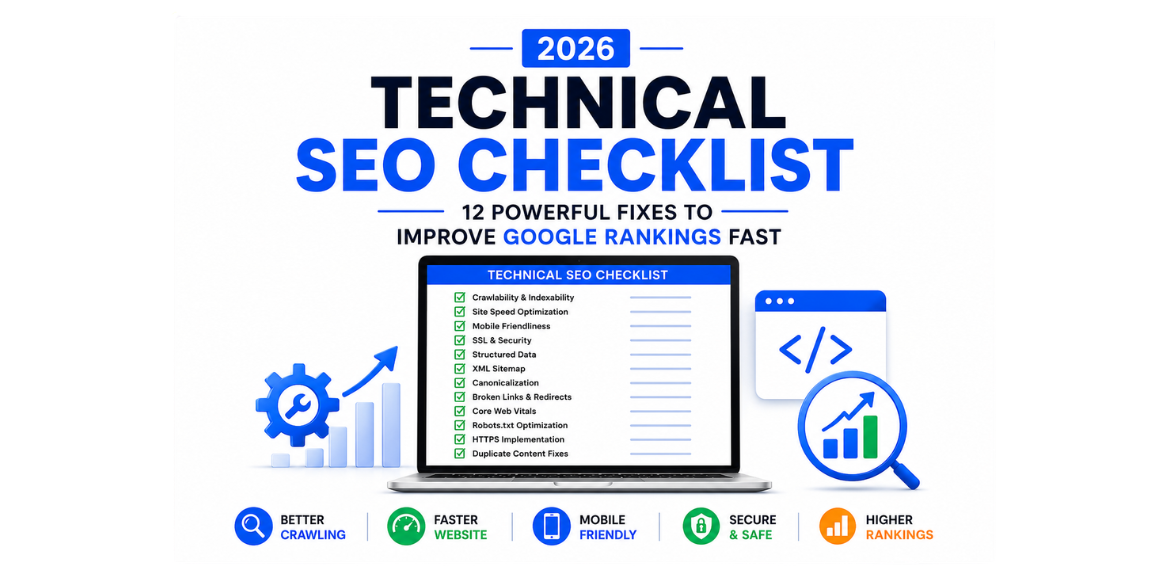
Technical SEO Checklist for 2026: 12 Powerful Fixes to Improve Google Rankings Fast
Introduction
If your website is not ranking on Google even after publishing content regularly, the problem may not be your content — it could be your technical SEO.
Many business websites struggle with:
- Slow loading speed
- Indexing issues
- Broken links
- Poor mobile performance
- Crawl errors
- Weak website structure
These technical SEO issues can prevent your pages from ranking, reduce organic traffic, and hinder lead generation.
If you are already working on website optimization strategies and improving search visibility, technical SEO should be your next priority.
In this complete technical SEO checklist for 2026, you’ll learn the most important fixes that help improve website performance, boost search visibility, and increase Google rankings.
What Is Technical SEO?
Technical SEO is the process of optimizing your website’s technical structure so that search engines can crawl, index, and rank pages efficiently.
Unlike content SEO, technical SEO focuses on:
- Website speed
- Mobile optimization
- Crawlability
- Indexing
- Security
- Website architecture
- Core Web Vitals
A technically optimized website improves both user experience and search engine performance.
For businesses trying to improve online visibility, combining technical SEO with local SEO strategies can significantly improve rankings.
Why Technical SEO Is Important in 2026
Google now prioritizes websites that offer fast, smooth, and user-friendly experiences.
Even high-quality content may fail to rank if your website has technical issues.
Strong technical SEO helps:
- Improve organic rankings
- Increase website traffic
- Reduce bounce rate
- Improve user experience
- Boost conversions
- Help pages get indexed faster
Without technical SEO, your website can lose visibility even if your content is good.
You can also combine technical SEO with AI-powered SEO optimization techniques to improve performance and automation.
Technical SEO Checklist for Better Rankings
1. Improve Website Loading Speed
Website speed is one of the biggest ranking factors in 2026.
A slow website creates a poor user experience and increases bounce rate.
How to improve website speed:
- Compress images
- Enable browser caching
- Use LiteSpeed Cache or CDN
- Minify CSS and JavaScript
- Remove unnecessary plugins
- Enable lazy loading
Faster websites usually perform better in search rankings and conversions.
You can also improve speed by implementing landing page optimization strategies that reduce unnecessary page elements.
2. Optimize Core Web Vitals
Core Web Vitals measure real user experience on your website.
Google mainly focuses on:
- Largest Contentful Paint (LCP)
- Interaction to Next Paint (INP)
- Cumulative Layout Shift (CLS)
Poor Core Web Vitals can negatively affect rankings and engagement.
Best optimization practices:
- Reduce server response time
- Optimize images and fonts
- Improve mobile responsiveness
- Prevent layout shifts
3. Fix Crawl Errors
Search engines must crawl your website properly to rank pages.
Common crawl issues include:
- 404 errors
- Redirect loops
- Broken internal links
- Blocked pages
- Server errors
Use Google Search Console and Semrush Site Audit regularly to identify and fix crawl problems.
Businesses facing crawl issues often experience website ranking problems on Google and reduced indexing.
4. Create and Submit XML Sitemap
An XML sitemap helps Google discover and index pages more efficiently.
Your sitemap should include:
- Blog pages
- Service pages
- Landing pages
- Important website URLs
After creating the sitemap:
- Submit it in Google Search Console
- Update it regularly
5. Optimize Robots.txt File
The robots.txt file tells search engines which pages can or cannot be crawled.
Incorrect robots.txt settings may accidentally block important pages from indexing.
Best practices:
- Allow important pages
- Block admin or duplicate pages
- Add the sitemap URL properly
6. Use HTTPS Security
HTTPS is an important trust and ranking factor.
A secure website:
- Protects user data
- Builds credibility
- Improves SEO trust signals
If your website still uses HTTP, switch to HTTPS immediately.
7. Fix Broken Links
Broken links hurt both SEO and user experience.
Regularly check:
- Internal broken links
- External broken links
- Missing images
- Redirect chains
A clean website structure improves crawlability and rankings.
8. Optimize Mobile Responsiveness
Google uses mobile-first indexing, which means mobile experience matters more than ever.
Your website should:
- Load properly on all devices
- Have a responsive design
- Use readable font sizes
- Maintain proper spacing and navigation
Mobile-friendly websites perform better in search results.
You can combine this with a conversion-focused landing page design for better lead generation.
9. Add Schema Markup
Schema markup helps search engines understand website content better.
Schema can improve:
- Rich snippets
- FAQ visibility
- Search appearance
- Click-through rate
Common schema types include:
- FAQ schema
- Article schema
- Breadcrumb schema
- Local business schema
10. Improve Internal Linking
Internal links help distribute page authority and improve website structure.
Strong internal linking:
- Helps Google crawl pages faster
- Improves engagement
- Supports keyword rankings
Link related blogs, service pages, and landing pages naturally.
11. Optimize Website Images
Large image files slow down websites and affect SEO performance.
Image optimization tips:
- Compress images
- Use WebP format
- Add descriptive alt text
- Use correct dimensions
- Enable lazy loading
Optimized images improve both speed and user experience.
12. Use Canonical Tags Correctly
Canonical tags help prevent duplicate content issues.
They tell Google which version of a page should be indexed.
Canonical optimization helps:
- Consolidate ranking signals
- Avoid duplicate indexing
- Improve SEO clarity
Common Technical SEO Mistakes That Hurt Rankings
Many websites fail to rank because of avoidable technical SEO mistakes, such as:
- Slow website speed
- Poor mobile optimization
- Missing meta tags
- Broken links
- Duplicate content
- Incorrect redirects
- Crawl errors
- Unoptimized images
Regular technical SEO audits help prevent these problems.
You can also combine technical SEO improvements with content marketing and SEO strategies to improve long-term organic growth.
Best Technical SEO Tools in 2026
Here are some powerful tools for technical SEO analysis:
- Google Search Console
- Semrush Site Audit
- Google PageSpeed Insights
- Screaming Frog SEO Spider
- GTmetrix
- Ahrefs Webmaster Tools
These tools help identify technical SEO issues and improve website performance.
Conclusion
Technical SEO is the foundation of successful SEO performance. Without proper technical optimization, even well-written content may struggle to rank on Google.
By following this technical SEO checklist for 2026, businesses can:
- Improve website rankings
- Increase organic traffic
- Enhance user experience
- Improve website speed
- Boost search visibility
Regular technical SEO optimization is essential for long-term growth and better Google rankings.
How Adikarah Helps Businesses Improve Technical SEO
Technical SEO can directly impact your website rankings, organic traffic, and lead generation. At Adikarah, we help businesses identify and fix technical SEO issues that may be affecting website performance and search visibility.
Our technical SEO optimization services focus on improving:
- Website speed and Core Web Vitals
- Crawlability and indexing issues
- Mobile responsiveness
- Broken links and redirect errors
- Schema markup implementation
- Internal linking structure
- Website security and HTTPS optimization
We use advanced SEO tools and data-driven strategies to improve website health, search engine visibility, and overall user experience.
Whether you want to improve rankings, increase organic traffic, or optimize website performance, Adikarah helps businesses build a strong technical SEO foundation for long-term growth.
Ready to Improve Your Website Rankings?
Get a complete technical SEO audit and discover the issues affecting your website performance.
FAQS
1. What is technical SEO?

2. Why is technical SEO important for Google rankings?

3. How can technical SEO improve website performance?

4. What are the most important technical SEO factors in 2026?

- Core Web Vitals
- Website speed
- Mobile-first optimization
- HTTPS security
- XML sitemap
- Schema markup
- Internal linking
- Crawlability and indexing
5. How does Adikarah help with technical SEO optimization?