


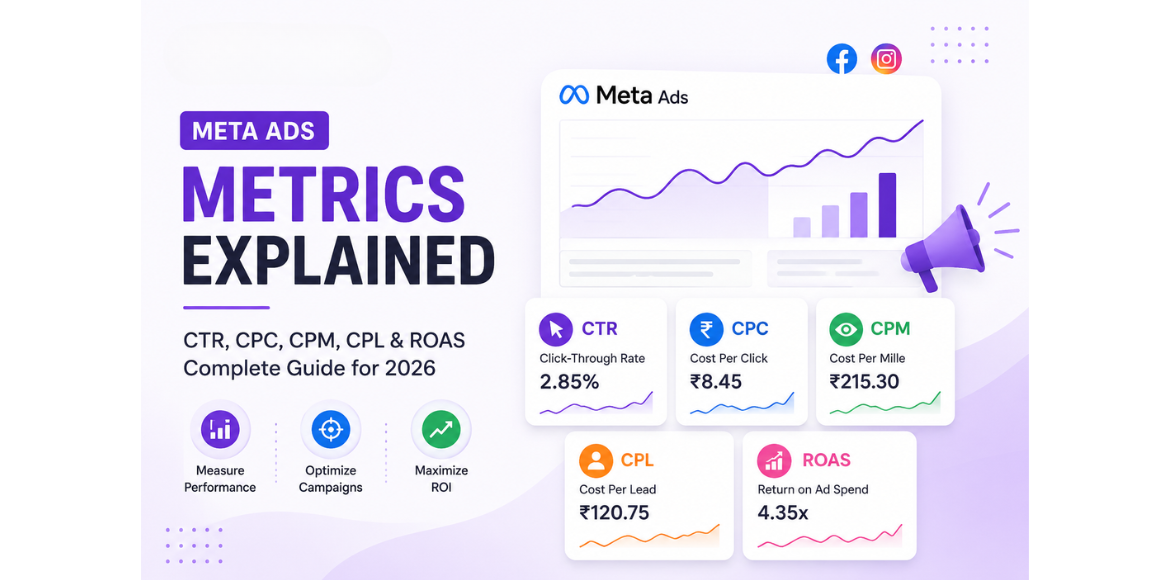
Meta Ads Metrics Explained: CTR, CPC, CPM, CPL & ROAS (Complete Guide for 2026)
Introduction
Meta Ads (formerly Facebook Ads) are one of the most effective ways to reach potential customers on Facebook and Instagram. However, creating an ad is only the first step. To know whether your campaign is successful, you need to understand the metrics that measure its performance.
Many businesses focus only on clicks or impressions, but these numbers alone don’t reveal whether your advertising budget is being used effectively. Metrics like CTR, CPC, CPM, CPL, and ROAS provide valuable insights into how your ads are performing and where improvements can be made.
In this guide, we’ll explain each of these key metrics, how they’re calculated, why they matter, and how you can use them to improve your Meta Ads campaigns.
Before optimizing your Meta Ads campaigns, it’s important to understand how they compare with other paid advertising platforms. If you’re unsure whether Meta Ads or Google Ads are the right choice for your business, read our Google Ads vs Facebook Ads: Which is Better for Businesses in 2026? guide.
What Are Meta Ads Metrics?
Meta Ads metrics are performance indicators that help advertisers evaluate the success of their campaigns. They provide insights into audience engagement, advertising costs, lead generation, and return on investment. These metrics become even more powerful when combined with a well-planned PPC advertising strategy that aligns with your business goals.
By monitoring these metrics regularly, you can:
- Measure campaign performance
- Improve audience targeting
- Optimize ad creatives
- Reduce advertising costs
- Generate more leads
- Increase overall ROI
Why Are Meta Ads Metrics Important?
Without tracking the right metrics, it’s difficult to know whether your campaigns are achieving their goals. Meta Ads metrics help you understand what’s working and what needs improvement.
For example:
- A high CTR means your ad is attracting attention.
- A low CPC indicates you’re getting clicks at a lower cost.
- A low CPL shows you’re generating leads efficiently.
- A high ROAS means your campaigns are delivering a strong return on investment.
Tracking these metrics allows you to make data-driven decisions instead of relying on guesswork.
Understanding the Meta Ads Funnel
Different metrics become important at different stages of your marketing funnel.
Funnel Stage | Goal | Important Metrics |
Awareness | Reach more people | CPM, Reach, Impressions |
Consideration | Increase engagement | CTR, CPC |
Conversion | Generate leads or sales | CPL, CPA, ROAS |
Understanding which metrics matter at each stage helps you evaluate campaigns more accurately.
1. CTR (Click-Through Rate)
What is CTR?
CTR measures the percentage of users who clicked on your ad after seeing it. It indicates how attractive and relevant your advertisement is.
Formula
CTR = (Clicks ÷ Impressions) × 100
Example
- Impressions: 20,000
- Clicks: 600
CTR = 3%
Why CTR Matters
A higher CTR usually means:
- Your ad creative grabs attention.
- The headline is compelling.
- Your audience targeting is accurate.
- The call-to-action encourages clicks.
How to Improve CTR
- Use high-quality images or videos. User-generated content (UGC) often performs better than traditional promotional creatives because it feels more authentic and increases engagement.
- Write benefit-focused ad copy.
- Test different headlines.
- Add a strong call-to-action.
- Target the right audience.
- Refresh creatives regularly to avoid ad fatigue.
2. CPC (Cost Per Click)
What is CPC?
CPC measures the average amount you pay whenever someone clicks on your advertisement.
Formula
CPC = Total Ad Spend ÷ Total Clicks
Example
- Ad Spend: ₹5,000
- Clicks: 1,000
CPC = ₹5
Why CPC Matters
A lower CPC helps you:
- Drive more traffic within the same budget.
- Reduce advertising costs.
- Improve campaign efficiency.
Tips to Reduce CPC
- Improve your CTR.
- Refine audience targeting.
- Test multiple ad creatives.
- Use engaging videos.
- Optimize ad relevance.
3. CPM (Cost Per Mille)
What is CPM?
CPM refers to the amount you pay for every 1,000 impressions your ad receives. It is commonly used for brand awareness campaigns.
Formula
CPM = (Ad Spend ÷ Impressions) × 1,000
Example
- Spend: ₹3,000
- Impressions: 100,000
CPM = ₹30
Why CPM Matters
CPM helps you understand how expensive it is to reach your target audience. A higher CPM may indicate increased competition or a highly targeted audience.
How to Optimize CPM
- Broaden your audience when appropriate.
- Improve ad quality.
- Test different placements.
- Avoid audience overlap.
4. CPL (Cost Per Lead)
What is CPL?
CPL measures how much it costs to generate one lead through your Meta Ads campaign. It is one of the most important metrics for businesses focused on lead generation.
Formula
CPL = Total Ad Spend ÷ Number of Leads
Example
- Ad Spend: ₹12,000
- Leads: 120
CPL = ₹100
Why CPL Matters
Lowering your CPL allows you to acquire more potential customers without increasing your marketing budget. However, the quality of leads is just as important as the cost.
Tips to Reduce CPL
- Improve your landing page.
- Simplify lead forms.
- Target high-intent audiences.
- Test different offers and creatives.
- Use retargeting campaigns.
5. ROAS (Return on Ad Spend)
What is ROAS?
ROAS measures how much revenue you earn for every rupee spent on advertising. It helps determine whether your campaigns are profitable.
Formula
ROAS = Revenue Generated ÷ Ad Spend
Example
- Revenue: ₹2,50,000
- Ad Spend: ₹50,000
ROAS = 5x
This means every ₹1 spent on advertising generated ₹5 in revenue.
Why ROAS Matters
ROAS is one of the most valuable metrics for businesses running sales campaigns because it directly measures profitability.
Tips to Improve ROAS
- Focus on high-converting audiences.
- Improve landing page experience.
- Retarget previous website visitors.
- Test multiple creatives and offers.
- Monitor campaign performance regularly.
Meta Ads Metrics Comparison
Metric | Measures | Ideal Goal |
CTR | Clicks after impressions | Higher |
CPC | Cost per click | Lower |
CPM | Cost per 1,000 impressions | Lower (depends on campaign) |
CPL | Cost per lead | Lower while maintaining lead quality |
ROAS | Revenue from ad spend | Higher |
Common Mistakes to Avoid
Many advertisers struggle to achieve good results because they focus on only one metric. Here are some common mistakes to avoid:
- Judging campaign success only by CTR.
- Ignoring landing page performance.
- Targeting audiences that are too broad or too narrow.
- Running the same creatives for too long.
- Making decisions without enough campaign data.
- Failing to monitor ROAS and conversion rates.
- Sending users to poorly optimized landing pages with slow loading speeds.
Best Practices for Better Meta Ads Performance
To improve your Meta Ads campaigns, follow these best practices:
- Define clear campaign objectives.
- Use audience segmentation for better targeting.
- Create compelling visuals and ad copy.
- Test different ad formats with A/B testing.
- Optimize landing pages for conversions.
- Track campaign performance regularly.
- Monitor your website performance alongside your Meta Ads using tools like Google Analytics and Google Search Console to identify opportunities for better conversions.
- Scale campaigns only after consistent results.
- Review metrics weekly and make data-driven adjustments.
Conclusion
Understanding CTR, CPC, CPM, CPL, and ROAS is essential for running successful Meta Ads campaigns. Each metric provides valuable insights into different aspects of your campaign, from audience engagement to profitability. Instead of focusing on a single number, analyze these metrics together to identify opportunities for improvement.
Regularly reviewing your campaign performance, testing new strategies, and optimizing your audience targeting and creatives will help you generate better results while making the most of your advertising budget.
Looking to improve your Meta Ads performance and generate high-quality leads?
Adikarah Tech specializes in creating data-driven Meta advertising campaigns that help businesses increase conversions, reduce advertising costs, and maximize return on investment.
Contact us today to take your digital marketing strategy to the next level.
FAQS
What is the most important Meta Ads metric?

What is a good CTR for Meta Ads?

Why is my CPC high?

Can I have a high CTR but low sales?

How can I improve Meta Ads conversions?