
Entity SEO Explained: How Google Understands Content and Improves Rankings (2026 Guide)
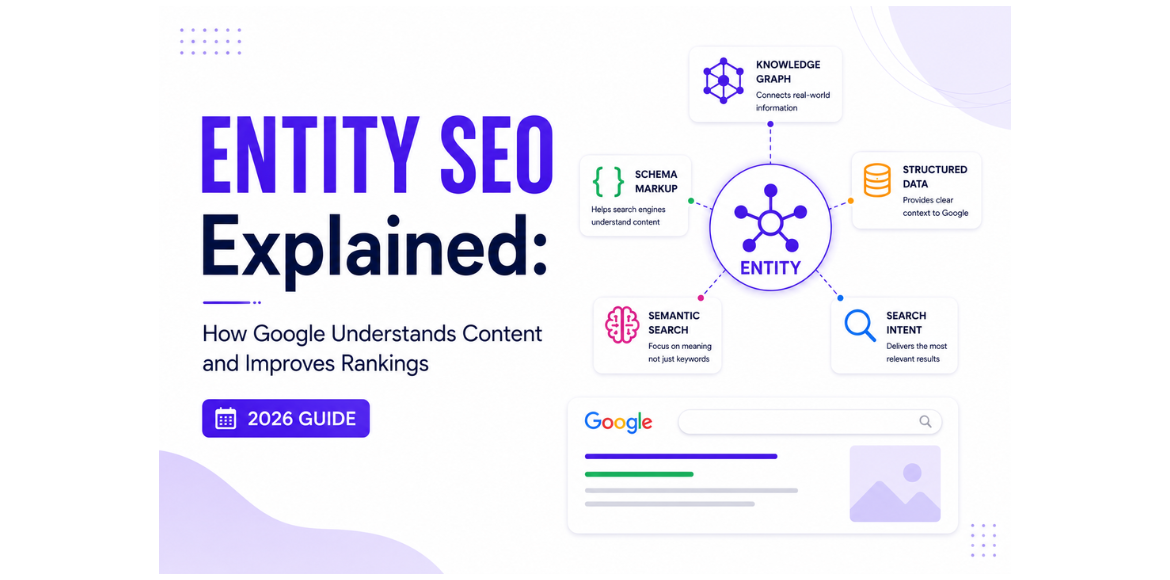
Entity SEO Explained – How Google Understands Content and Improves Rankings with Knowledge Graph, Structured Data, and Semantic Search (2026 Guide)
Introduction

Google’s search algorithm has evolved far beyond matching keywords. Today, Google focuses on understanding the meaning behind your content using entities, relationships, and context. This shift has made Entity SEO one of the most important aspects of modern search engine optimization.

If you still rely only on keyword optimization, you’re missing a significant opportunity to improve your rankings. Google’s AI-powered search systems—including the Knowledge Graph, Natural Language Processing (NLP), Semantic Search, and AI Overviews—analyze how concepts connect rather than simply counting keyword usage.

In this guide, you’ll learn what Entity SEO is, why it matters in 2026, how Google identifies entities, and practical strategies to optimize your content for better visibility.

What is Entity SEO?

Entity SEO is the practice of optimizing your content around people, places, organizations, products, concepts, and events—known as entities—instead of focusing only on keywords.

Unlike traditional SEO, which emphasizes keyword frequency, Entity SEO helps Google understand the actual meaning of your content and how it relates to other topics.

For example:

Keyword SEO

Best Digital Marketing Agency

Entity SEO

Google connects these entities to understand your page more accurately.

What is an Entity in SEO?

An entity is any uniquely identifiable object or concept that Google can understand independently of language.

Examples include:

  • Google
  • Bangalore
  • Digital Marketing
  • Search Engine Optimization
  • Meta Ads
  • Google Analytics
  • Adikarah Tech
  • Artificial Intelligence

Entities have their own relationships with other entities, helping Google determine relevance and authority.

How Google Understands Entities

userGoogle combines multiple technologies to understand content:

Google Knowledge Graph

Stores billions of connected entities and their relationships.

Natural Language Processing (NLP)

Analyzes sentence meaning rather than individual keywords.

Semantic Search

Understands the context and user intent behind search queries.

Machine Learning

Continuously improves search result quality based on  behavior.

AI Overviews

Generates AI-powered summaries by understanding entities and their relationships across trusted content.

Entity SEO vs Keyword SEO

Keyword SEO

Entity SEO

Focuses on keywords

Focuses on concepts

Keyword density

Topic relationships

Exact-match optimization

Semantic understanding

Limited context

Rich context

Traditional ranking signals

AI-powered relevance

Why Entity SEO Matters in 2026

Entity SEO helps your website:

As AI-powered search evolves, Google’s understanding of entities becomes increasingly important for ranking competitive content.

The Google Knowledge Graph Explained

The Knowledge Graph is Google’s database of entities and their relationships.

For example:

Digital Marketing
→ SEO
→ Google Ads
→ Content Marketing
→ Social Media
→ Analytics
→ Local SEO

When your content clearly explains these relationships, Google gains stronger confidence in your expertise.

How Semantic SEO Supports Entity SEO

Semantic SEO expands your content beyond a single keyword by covering related topics naturally.

Instead of repeating:

Entity SEO

Include related concepts like:

  • Semantic Search
  • Knowledge Graph
  • NLP
  • Structured Data
  • Topical Authority
  • Search Intent
  • Internal Linking
  • AI Search

This creates comprehensive content that better satisfies user intent.

The Role of Structured Data

Structured data (Schema.org markup) provides explicit information about your content.

Useful schema types include:

  • Article
  • Organization
  • FAQ
  • Breadcrumb
  • Local Business
  • Person
  • Product

Adding structured data improves Google’s understanding of your pages and may enhance search result appearance.

How to Optimize Content Using Entity SEO

Research related entities

Use Google Search, Knowledge Panels, and trusted SEO tools to identify important entities.

Cover topics comprehensively

Answer related questions and explain associated concepts.

Build topical clusters

Create supporting articles around your main topic.

Use internal links

Connect related content to reinforce entity relationships.

Add structured data

Implement appropriate schema markup.

Include credible sources

Reference authoritative resources to strengthen trust.

Common Entity SEO Mistakes

  • Keyword stuffing
  • Ignoring search intent
  • Thin content
  • Missing internal links
  • No structured data
  • Poor topical coverage
  • Outdated information

Best Tools for Entity Research

Entity SEO Checklist

✅ Identify primary entities

✅ Cover related concepts

✅ Add semantic keywords

✅ Use structured data

✅ Optimize internal linking

✅ Build topical authority

✅ Match search intent

✅ Update content regularly

Conclusion

Entity SEO is reshaping how websites rank in Google. By optimizing around entities, semantic relationships, structured data, and topical authority, you help search engines understand your content more effectively.

As AI-driven search continues to evolve in 2026, businesses that embrace Entity SEO will be better positioned to earn higher rankings, greater visibility, and more qualified organic traffic.

If you’re looking to improve your website’s SEO strategy, focusing on Entity SEO is a smart step toward long-term search success.

Ready to Improve Your SEO with Entity-Based Optimization?

Entity SEO is no longer optional—it’s a key part of helping Google understand your content and improving your search visibility. By combining entity optimization, semantic SEO, structured data, and topical authority, you can build a stronger foundation for long-term organic growth.

If you’re looking to improve your website’s rankings, increase organic traffic, and stay ahead of Google’s evolving search algorithms, Adikarah Tech can help. Our SEO experts create data-driven strategies tailored to your business goals.

📞 Get in touch with Adikarah Tech today for a free SEO consultation .

FAQS

1. What is Entity SEO?
Digital marketing services in Bangalore
Entity SEO is the process of optimizing content around identifiable concepts such as people, places, organizations, products, and topics instead of relying only on keywords. It helps Google better understand the meaning and context of your content.
2. How is Entity SEO different from traditional keyword SEO?

Digital marketing services in Bangalore
Traditional keyword SEO focuses on optimizing specific search terms, while Entity SEO emphasizes the relationships between concepts. This allows Google to interpret content more accurately using semantic search, the Knowledge Graph, and AI-powered algorithms.
3. Does Entity SEO improve Google rankings?

Digital marketing services in Bangalore
Yes. Entity SEO can improve your website's relevance, topical authority, and search visibility. By helping Google understand your content more effectively, it increases your chances of ranking higher for related search queries and appearing in AI-powered search results.
4. What role does structured data play in Entity SEO?

Our Digital Marketing Services
Structured data provides additional context about your content using Schema.org markup. It helps search engines identify entities more accurately, improves content understanding, and can make your pages eligible for rich results in Google Search.
5. How can I optimize my website for Entity SEO?

Digital marketing services in Bangalore
To optimize for Entity SEO, create comprehensive content around related topics, use semantic keywords naturally, implement structured data, build strong internal links, earn quality backlinks, and demonstrate expertise and topical authority across your website.

Leave A Comment

Create your account