


How to Build Topical Authority for SEO in 2026: The Complete Guide
Introduction
SEO in 2026 is no longer about targeting a handful of keywords and expecting consistent rankings. Search engines have evolved to understand topics, entities, relationships, and user intent better than ever before. As AI-powered search experiences continue to grow, websites that demonstrate deep expertise on a subject are gaining a significant advantage.
This is where Topical Authority comes into play.
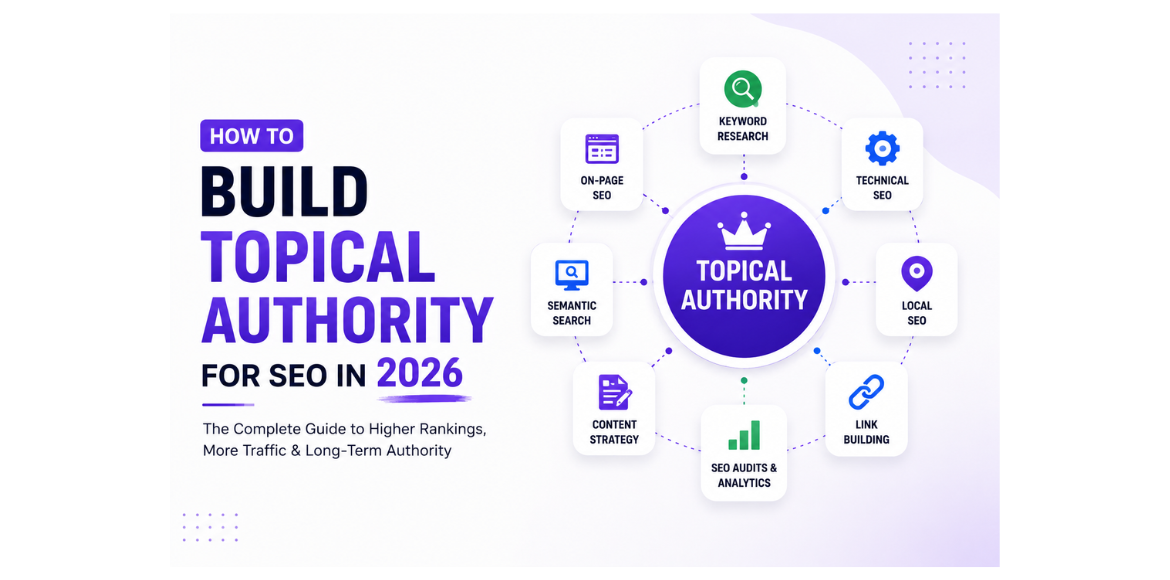
Topical authority is the process of becoming a trusted source for a specific topic by creating comprehensive, interconnected, and high-quality content. Websites with strong topical authority tend to rank higher, attract more organic traffic, and earn greater trust from both users and search engines.
In this guide, you’ll learn how to build topical authority for SEO in 2026 and why it has become one of the most important ranking factors for long-term organic growth.
What Is Topical Authority in SEO?
Topical authority refers to the expertise and credibility a website establishes around a specific subject.
Instead of evaluating individual pages in isolation, Google now assesses how well a website covers an entire topic ecosystem.
For example, if your website focuses on SEO, publishing a single article about keyword research isn’t enough. To establish topical authority, your website should also cover:
- Technical SEO
- On-Page SEO
- Local SEO
- Link Building
- Google Search Console
- SEO Audits
- Content Optimization
- Search Intent
- AI SEO Strategies
The more comprehensive your content coverage, the more likely Google is to view your website as an authoritative source.
Why Topical Authority Matters More Than Ever in 2026
Improved Search Rankings
Google prefers websites that provide complete solutions to user queries rather than websites that publish disconnected content.
Increased Organic Traffic
A strong topical authority strategy helps your website rank for hundreds or even thousands of related keywords.
Better User Experience
Visitors can easily navigate between related articles, increasing engagement and reducing bounce rates.
Stronger Brand Trust
Users trust websites that consistently provide valuable and reliable information.
Better AI Search Visibility
AI search engines and Google’s AI Overviews often favor authoritative websites when generating responses.
Google’s Shift from Keywords to Topics
In the past, SEO focused heavily on keyword optimization. Today, Google evaluates the overall context of your content.
For example, if your website consistently publishes content about SEO, Google expects to find supporting content such as:
- Keyword research
- Search Console insights
- CTR optimization
- Technical SEO audits
- Content strategy
This shift explains why websites with strong topic clusters often outperform websites targeting isolated keywords.
Related Reading:
Domain Authority vs Topical Authority
Many businesses focus solely on backlinks and domain authority.
While backlinks remain important, topical authority has become equally critical.
Domain Authority | Topical Authority |
Focuses on overall website strength | Focuses on subject expertise |
Influenced by backlinks | Influenced by content depth |
Broad ranking signal | Topic-specific ranking signal |
Measures website credibility | Measures expertise and relevance |
A website with lower domain authority but stronger topical authority can often outrank larger competitors.
How Search Engines Measure Topical Authority
Search engines evaluate several factors when determining topical authority.
Content Depth
Comprehensive articles covering multiple aspects of a topic.
Internal Linking
Strong connections between related pages.
Semantic Relevance
Use of related concepts, entities, and supporting keywords.
User Engagement
Time on page, click-through rates, and user interaction.
E-E-A-T Signals
Experience, Expertise, Authoritativeness, and Trustworthiness.
Content Freshness
Regularly updated and relevant content.
Step 1: Build a Strong Keyword Research Framework
Keyword research is the foundation of topical authority.
Instead of targeting a single keyword, identify all related topics within your niche.
Example
Primary Topic:
SEO
Supporting Topics:
- Keyword Research
- Technical SEO
- Local SEO
- SEO Audits
- Link Building
- Search Intent
- Content Marketing
- Google Search Console
Covering these supporting topics helps Google understand your expertise.
Step 2: Create Topic Clusters and Pillar Pages
A topic cluster consists of one comprehensive pillar page supported by multiple related articles.
Example SEO Topic Cluster
Pillar Page
Complete Guide to SEO in 2026
Supporting Articles
- Keyword Research Guide
- Technical SEO Checklist
- Local SEO Strategies
- SEO Audit Guide
- Internal Linking Best Practices
- Link Building Strategies
- Google Search Console Guide
Every supporting article should link back to the pillar page and other relevant articles.
This structure creates a strong content ecosystem.
Step 3: Use Google Search Console to Identify Content Gaps
Google Search Console is one of the most powerful tools for building topical authority.
Analyze:
- High-impression keywords
- Low CTR pages
- Queries you rank for but haven’t covered fully
- Emerging keyword opportunities
For example, if you notice impressions for “semantic SEO” but don’t have a dedicated article, that’s a content gap worth filling.
Related Reading:
- How to Find Low-Hanging SEO Opportunities in Google Search Console
- How to Increase Organic CTR in Google Search
Step 4: Optimize for Semantic Search
Google no longer relies solely on exact-match keywords.
Instead, it evaluates semantic relationships.
For a page about SEO, include related concepts such as:
- Organic Traffic
- Search Rankings
- SERP Features
- User Intent
- Content Strategy
- Backlinks
- Technical Optimization
Semantic SEO strengthens topical relevance and improves rankings.
Step 5: Strengthen Internal Linking
Internal linking plays a major role in topical authority.
Benefits include:
- Better crawlability
- Improved user navigation
- Stronger topic associations
- Distribution of page authority
Every new article should link to existing relevant content.
For example:
A blog about topical authority should link to:
- Keyword Ranking Guides
- Internal Linking Strategies
- SEO Audit Resources
- Search Console Tutorials
Step 6: Create High-Quality Content Consistently
Publishing one excellent article isn’t enough.
Topical authority requires continuous content creation.
Content Best Practices
- Write comprehensive guides
- Answer common user questions
- Include case studies
- Use data and examples
- Update outdated content regularly
Consistency signals expertise to search engines.
Step 7: Build Authority Through Content Clusters
Let’s look at a Digital Marketing content cluster.
Pillar Topic
Digital Marketing
Supporting Topics
- SEO
- Google Ads
- Meta Ads
- Social Media Marketing
- Content Marketing
- Conversion Rate Optimization
- Analytics
Related Reading:
- Why Your Meta Ads Get Clicks but No Sales Leads
- How to Reduce Cost Per Lead (CPL) in Meta Ads
- Increase Website Traffic and Convert Leads
Covering an entire subject area helps search engines understand your expertise.
Step 8: Earn Relevant Backlinks
Backlinks remain a strong trust signal.
Focus on acquiring links from:
- Industry blogs
- Business websites
- News publications
- Resource pages
- Guest posting opportunities
Quality matters more than quantity.
Step 9: Optimize for E-E-A-T
Google evaluates:
Experience
Demonstrate practical knowledge.
Expertise
Show deep understanding of your niche.
Authoritativeness
Build recognition within your industry.
Trustworthiness
Provide accurate and transparent information.
Ways to improve E-E-A-T:
- Publish case studies
- Add author bios
- Include testimonials
- Reference reputable sources
Step 10: Measure Topical Authority Growth
Track performance using:
Monitor:
- Organic traffic growth
- Ranking keywords
- Impressions
- CTR
- Average ranking position
Consistent growth across these metrics indicates increasing topical authority.
Topical Authority and AI Search
AI-powered search engines are changing SEO rapidly.
Google AI Overviews, ChatGPT search experiences, and generative search tools prioritize:
- Comprehensive content
- Subject expertise
- Strong internal linking
- Reliable sources
Websites with strong topical authority are more likely to be referenced in AI-generated search results.
Related Reading:
Common Mistakes That Prevent Topical Authority
Publishing Random Topics
Stay focused on your niche.
Weak Internal Linking
Connect related content strategically.
Thin Content
Create comprehensive resources.
Ignoring Search Intent
Understand what users want.
Not Updating Content
Refresh content regularly.
Conclusion
Building topical authority in 2026 requires more than publishing occasional blog posts. It demands a strategic approach focused on topic clusters, semantic SEO, internal linking, content depth, and consistent optimization.
By creating a comprehensive content ecosystem around your niche, you can improve rankings, increase organic traffic, and position your website as a trusted industry authority.
As search engines continue moving toward AI-powered results, topical authority will become one of the most important factors for sustainable SEO success.
Ready to Build Topical Authority and Dominate Search Results?
At Adikarah Tech, we help businesses create SEO-driven content strategies that improve rankings, increase organic traffic, and establish long-term authority.
Our SEO Services Include:
✅ SEO Audits & Competitor Analysis
✅ Keyword Research & Topic Clustering
✅ Technical SEO Optimization
✅ Internal Linking Strategy
✅ Content Marketing & Blog Planning
✅ Organic Traffic Growth Solutions
Want to become the go-to authority in your industry? Contact Adikarah Tech today for a customized SEO strategy.
FAQS
1. What is topical authority in SEO?

2. Why is topical authority important for SEO?

3. How long does it take to build topical authority?

4. Is topical authority more important than domain authority?

5. How many articles are needed to build topical authority?