


SEO Audit Checklist for Small Businesses (2026): 50+ Checks to Improve Google Rankings
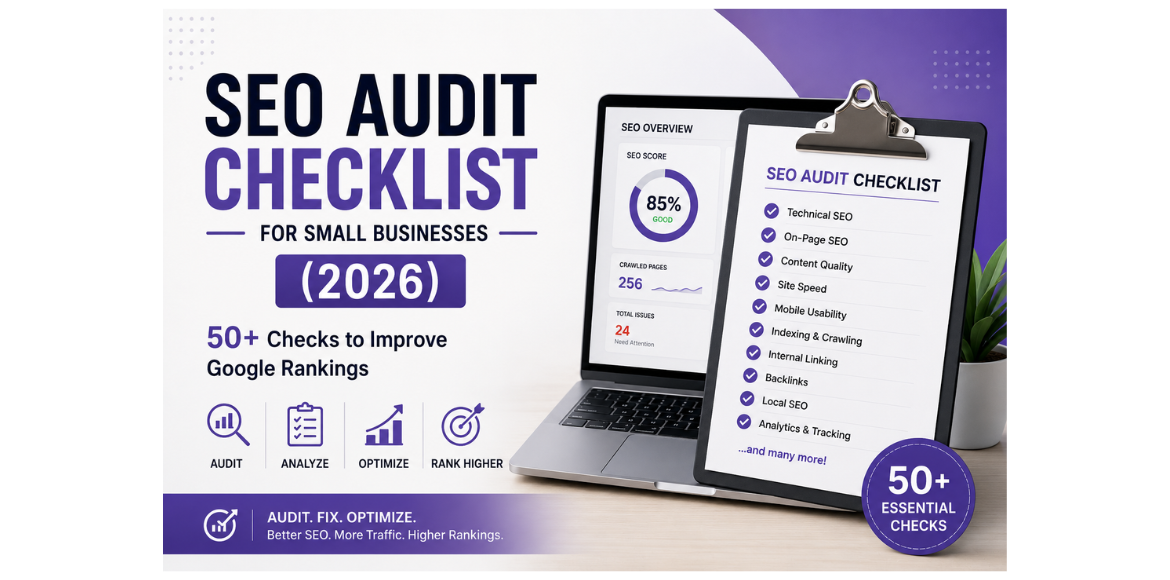
Introduction
If your website isn’t attracting enough organic traffic or generating quality leads, it’s time to perform an SEO audit. An SEO audit helps identify technical issues, content gaps, indexing problems, and user experience factors that may be preventing your website from ranking higher on Google.
In 2026, Google’s ranking algorithms continue to prioritize user experience, helpful content, Core Web Vitals, AI search readiness, and technical website performance. Regular SEO audits help businesses stay competitive and ensure their websites meet the latest search engine requirements.
In this complete SEO audit checklist, you’ll learn over 50 essential checks that every small business should perform to improve Google rankings, increase website traffic, and generate more leads.
What Is an SEO Audit?
An SEO audit is the process of analyzing your website to identify issues that affect its visibility in search engines. It evaluates technical SEO, on-page optimization, website performance, content quality, internal linking, backlinks, and user experience.
An audit not only uncovers problems but also provides opportunities to improve rankings, increase traffic, and enhance overall website performance.
Why Small Businesses Need Regular SEO Audits
Search engine optimization isn’t something you do once and forget. Google updates its algorithms regularly, competitors improve their websites, and customer search behavior constantly evolves.
Regular SEO audits help you:
- Identify indexing issues before they impact rankings
- Improve website speed and user experience
- Fix technical SEO errors
- Discover pages losing traffic
- Improve keyword rankings
- Increase conversion opportunities
- Stay aligned with Google’s latest ranking factors
For most small businesses, performing an SEO audit every three to six months is recommended.
Technical SEO Audit Checklist
Technical SEO forms the foundation of a healthy website. If Google cannot crawl or understand your pages, your content may never reach potential customers.
Check Website Indexing
Open Google Search Console and ensure important pages are indexed. Look for pages showing statuses such as “Discovered – currently not indexed,” “Crawled – currently not indexed,” or other indexing issues.
Verify XML Sitemap
Your XML sitemap should include all important pages and be submitted to Google Search Console. Remove outdated or broken URLs and update the sitemap whenever new content is published.
Review Robots.txt
Ensure your robots.txt file isn’t blocking important pages or directories from being crawled by search engines.
Check HTTPS Security
Your website should use HTTPS on every page. Ensure HTTP versions redirect properly to HTTPS and eliminate mixed-content warnings.
Review Canonical Tags
Every important page should contain a self-referencing canonical tag to avoid duplicate content issues.
Fix Broken Links
Broken internal and external links negatively affect user experience and crawlability. Regularly identify and fix 404 errors.
On-Page SEO Checklist
Optimizing individual pages helps search engines understand your content and improves click-through rates.
Optimize Title Tags
Write unique title tags containing your target keyword naturally while keeping them within recommended length limits.
Write Compelling Meta Descriptions
Create informative meta descriptions that encourage users to click while accurately describing page content.
Use Proper Heading Structure
Organize your content using one H1 heading followed by logical H2 and H3 headings.
Optimize URLs
Use short, descriptive URLs that include relevant keywords and avoid unnecessary numbers or symbols.
Optimize Images
Compress images for faster loading and add descriptive ALT text that explains the image.
Content Quality Audit
High-quality content remains one of Google’s strongest ranking signals.
Review each important page and ask:
- Is the information accurate?
- Is it updated for 2026?
- Does it fully answer user intent?
- Is it more helpful than competing pages?
Update outdated statistics, improve readability, add recent examples, and expand thin content wherever necessary.
Internal Linking Audit
Internal links help search engines discover pages and distribute authority throughout your website.
Check that:
- Important pages receive multiple internal links.
- Anchor text is descriptive.
- No valuable pages are orphaned.
- Related articles link naturally to one another.
Strong internal linking improves both rankings and user navigation.
Website Speed Audit
Page speed directly impacts user experience and SEO performance.
Test your website using Google PageSpeed Insights or Lighthouse and optimize:
- Image sizes
- Browser caching
- CSS and JavaScript files
- Lazy loading
- Server response time
Fast-loading websites reduce bounce rates and improve conversions.
Core Web Vitals Audit
Google continues to prioritize Core Web Vitals as ranking signals.
Review:
- Largest Contentful Paint (LCP)
- Interaction to Next Paint (INP)
- Cumulative Layout Shift (CLS)
Address slow loading elements, layout shifts, and interaction delays to improve user experience.
Mobile SEO Audit
Since Google uses mobile-first indexing, your website must perform well on smartphones.
Verify:
- Responsive design
- Readable text
- Easy navigation
- Proper button spacing
- Fast mobile loading
- Mobile usability issues in Search Console
Google Search Console Audit
Google Search Console provides valuable insights into website performance.
Review:
- Index Coverage
- Performance Report
- Search Queries
- Page Experience
- Core Web Vitals
- Mobile Usability
- Manual Actions
Identify pages with high impressions but low CTR and optimize their titles and meta descriptions.
Google Analytics 4 Audit
Analyze your website’s performance using GA4.
Monitor:
- Organic traffic
- Landing pages
- User engagement
- Conversions
- Traffic sources
- Bounce rate
Understanding visitor behavior helps identify opportunities for improvement.
Backlink Audit
Backlinks remain an important ranking factor.
Review:
- Referring domains
- Lost backlinks
- Toxic links
- Anchor text distribution
Focus on earning relevant, high-quality backlinks rather than large quantities.
Local SEO Audit
If your business serves a local audience, optimize your local SEO presence.
Check:
- Google Business Profile optimization
- Business information consistency
- Customer reviews
- Local keywords
- Local schema markup
- Location-specific landing pages
AI Search Readiness Audit
As AI-powered search experiences become more common, your content should be structured to answer user questions clearly.
Ensure your content:
- Uses descriptive headings
- Includes FAQs
- Provides original insights
- Demonstrates expertise
- Answers questions directly
- Uses structured formatting
SEO Audit Tools
Several free and paid tools can simplify your audit process.
Useful tools include:
Quick SEO Audit Checklist
Before publishing or updating your website, verify:
- Website is indexed
- XML sitemap is submitted
- HTTPS is enabled
- Robots.txt is configured correctly
- Canonical tags are implemented
- Titles and meta descriptions are optimized
- Images include ALT text
- Internal links are added
- Website loads quickly
- Core Web Vitals pass Google’s recommendations
- Mobile usability issues are resolved
- Broken links are fixed
- Content is updated
- Structured data is implemented
- Local SEO is optimized
- Backlinks are monitored regularly
Conclusion
An SEO audit is one of the most effective ways to improve your website’s performance and maintain long-term search visibility. By regularly reviewing technical SEO, on-page optimization, content quality, website speed, mobile usability, internal linking, and analytics, small businesses can identify issues before they impact rankings.
Instead of waiting for traffic to decline, make SEO audits part of your regular digital marketing strategy. Consistent improvements not only help you rank higher on Google but also provide a better experience for your visitors, resulting in increased trust, engagement, and conversions.
Ready to Improve Your Website Rankings?
A complete SEO audit helps uncover hidden issues that may be affecting your website’s visibility and performance. If you’re looking to improve your Google rankings, increase organic traffic, and generate more leads, our SEO experts can help.
Contact Adikarah Tech today for a professional SEO audit and customized optimization strategy.
FAQS
1. What is an SEO audit?

2. How often should I perform an SEO audit?

3. Can I perform an SEO audit without paid tools?

4. What are the most important areas to check during an SEO audit?

5. Will an SEO audit improve my Google rankings?



Casey#danil[UzuduiDO,2,5]
Looking for helpful websites, I found a very informative website with articles, guides, tips, and useful information. It may be helpful for anyone looking for reliable information.
Details https://convivea.com/forums/index.php/topic,16062.0.html
kolca_tjMi
Подарите своей возлюбленной незабываемое впечатление — выберите кольцо с желтым бриллиантом и сделайте предложение, которое запомнится на всю жизнь.
Третье предложение второго абзаца.
Casey#gari2[UzuduiDO,2,5]
Изучал идеи для отпуска, наткнулся на хороший портал с обзорами интересных мест и праздничных мероприятий. Есть что почитать перед поездкой.
Узнать больше- https://mdktk.ru/idealnye-kulturnye-vyhodnye-s-nespeshnymi-progulkami-posescheniem-dostoprimechatelnostey-i-uyutnymi/